

I won’t be blogging much for the next week or so — I’m on a writing retreat in Vermont and have self-limited (and actually limited) access to the internet. Photos of cute Vermont buildings will be forthcoming at some later date.
Archived Posts
Displaying posts 171 - 180 of 878
By this point we’ve reached the existential phase of the amazonfail debacle, where everyone has acknowledged something happened, has vented their anger, and is now asking underlying questions — how and why did this happen? Who did it? And of course, should we still be concerned?
While Amazon’s “glitch” response is inadequate, it does seem to indicate that they’re planning on fixing it, which seems to me to have caused a certain wave of relaxation in those angered by the removal of GLBT literature, feminism and disability texts, and more. Yes, it’s very unlikely that Amazon did this deliberately. Yes, internet outrage at this point does little good (except possibly to Powell’s sale numbers). I’m just not sure people should be standing down yet. Even when it’s fixed, there are causes for concern. As explored in this Making Light post and comment thread, there are definitely plausible scenarios this occurring because of inadequacies in the meta-data provided by publishers and Amazon. (This post at Dear Author gives great specific meta-data breakdowns that may show why Playboy escaped the purge and Heather has Two Mommies did not.) However, as writer Lawrence Schimel said over at Making Light, somewhere, someone had to decide that “gay=morally objectionable” (‘adult’) in order for this to unfold. And as other commenters, such as albatross, mention there, Amazon didn’t give consumers a choice of filtered versus non-filtered searches.
And that’s what’s really troubling to me. Amazon has made an empire on selling everything all the time: KitchenAid mixers to people in pyjamas at 2 am, esoteric camera repair manuals to some dude on his lunch break, three books and a racquetball racket at the same time. They’re so huge that sales rank on Amazon is a crucial metric for a book’s performance. They chose to protect consumers from ‘potentially offensive content’ in a lazy, slipshod, and reductive way that stigmatized the mention of homosexuality and transgenderedness as much or more than explicit heterosexual acts, not to mention violence. They chose to remove their sales rank, important to publishers and authors, in order to change what consumers see. But before they did it stupidly, they chose to do it at all. They decided that an Amazon consumer didn’t get any say in whether they saw the plain search results or the Bowdlerized search results. They decided to abridge the full functionality of their website without notifying customers or letting them have a choice. They decided we are all children, and they know what’s best for us.
For a company that made its fortune on selling anything and everything, that’s a stupid decision. For a company that sells books, it’s wrong.
I don’t usually just post links to other blogs, but the study Zuska is talking about here is fascinating:
Would you describe a bridge as fragile, elegant, beautiful, peaceful, slender, pretty? Or as strong, dangerous, long, sturdy, big, towering? Lera Boroditsky, an assistant psychology professor at Stanford University, found that it depends – for native German and Spanish speakers, on whether your native tongue assigns a feminine or masculine gender to the noun bridge.
I’ve long been interested in the intricacies and contradictions of gendered language, both in the study of French and Latin and in the more subtle ways English is gendered. I’m glad this sort of rigorous research is going on, and I hope that this kind of work can inspire at least a few people to consider how deeply their firm ideas of gender are shaped by culture. We love to believe we are free agents, that the choices we make and beliefs we hold are our own. But we are rooted, growing out of a place, a culture, a family, even a religion. The more we acknowledge and analyze the things that shape us, the more we can grow beyond them. Our culture gives us meaning and common ground, but it can also be poisonous and stunting. Only by facing that can we fight it, and work to become truly free.
I think costuming is meaningful. Maybe that sounds odd, but it’s an important part of the look of a show, the messaging of a theatre production, et cetera.
But I have this problem, a disconnect between the way I think and the way Hollywood people do. It’s encapsulated well by a recent episode of Dollhouse, where the same professional thief character (being played by two different actresses) repeats that she she has rules to “never second-guess a client, and wear comfy shoes”. They say this twice, in two pairs of identical boots, with stilettos around six inches tall.
This dredged up one of my televisual pet peeves. Women in standing, walking and running professions in ridiculously high heels. Dr. Cameron, the female doctor on House, for example, working long hours and pursuing a suicidal patient. ’Cuz, you know, I always notice the wicked heels on hospital staff.
Now, I own heels. I can even walk in them. They can be pretty and fun. A chunky heel can even offer some comfort and ease of use. But we’re not talking about chunky heels, or cowboy boots. We’re talking about spikes at four inches plus, which may perhaps be an everyday shoe for Hollywood, but probably not for a professional thief, or a junior doctor, or…a homicide detective.
Now, admittedly all I know about how female homicide detectives dress I learned from Landsman’s dress code lectures on The Wire. On that show it involved pantsuits, and, at least in Greggs’s case, a sturdy chunk heel. Other shows (and shoes) vary: since Life is set in LA, it’s a little less dressy: Reese wears a button-up shirt under a jacket, usually, and again, a sensible heel like a cowboy or chunky boot (Sarah Shahi’s a lot shorter than her co-star, so some heel is usually in evidence.) But Castle, in the two episodes I’ve watched, has made me crazy. They have a very tall, model-tall in fact, actress playing an NYPD homicide detective. And while my suspension of disbelief is bruised by noting her four different up-to-the-minute coats in one episode (two leather) and trailing pashmina scarfs to match, it’s positively shattered when she brushes her impractical bangs out of her eyes in order to yell “NYPD” and kick down a door when we clearly saw her deadly wobble-pumps in the adjacent scene. Not to mention when she kicks a knife away from a suspect with a retro round-toe number better suited to ballroom than brawl.
Seriously, Hollywood, maybe your costumers like showroom shoes, maybe your directors just want the character to look ‘pretty’ and don’t care what that means, maybe the writer who knows the character’s personality gets no input into these choices at all, maybe you all live in a Hollywood bubble where women are all size zero and wear lipstick to bed. But out here in watcherland, we would like to be able to believe in our heroines as well as our heroes. Which means we need to believe a badass cop can chase down a perp or kick down a door. And having walked a block in her shoes, I feel certain she can’t.
Ryan’s family always gets together to celebrate birthdays. For some reason, we ended up doing mine over a month after it actually happened. I’m not used to doing this with birthdays, but when you do it with Christmas, it’s called “extending the Christmas joy”. It means you get presents long after you had any rational expectation of them. I got awesome presents, and one that I thought I would highlight on the old blog.
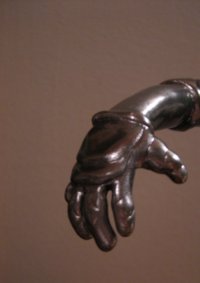
Greystork made a statue based on my story, “Burgerdroid”. Seriously. Someone made art because of something I wrote. Because of the first thing I’ve ever gotten published, no less. This is fantastic!
The sculpture reveals something crucial from the end of the story, so you might not want to click through if you haven’t read it. If you have read it, feast your eyes!
Top Ten Reasons You Should Be Watching "Life"
Felicity Shoulders Thursday March 26, 2009 @ 10:23 PM (UTC)A while back, I started watching Life. There were two reasons for this. One is that all the episodes that then existed were free online at Hulu. The other reason is Damian Lewis, who played Winters in Band of Brothers, and, along with Ron Livingston, made me feel very conflicted. Is it wrong to crush on actors when they’re playing real people who are as old as my grandpa and portraying important historical events? Oh, the conflict.
At any rate, I was hooked on Life immediately, but didn’t spread the news. I think I was obscurely ashamed of the show, mostly because it is weird. It’s a good weird, though. A very deliberate weird. So, I’m letting the world know: if you’re not watching Life, you should be.
Top Ten Reasons You Should Be Watching Life:
10. It’s not like every other cop show. Since the premise (cop Charlie Crews gets sentenced to life for triple murder he didn’t commit, then gets exonerated and insists on being a cop again as part of his settlement) is a little far-fetched, so is everything else. The murders, suspects and situations are zany, often surreal. It’s not a cop show that could be set anywhere but LA. It’s not a cop show you could confuse with any old procedural on the air.
9. Crews’s silly amounts of money. And the silly things the show does with it, like the musical chairs with Charlie’s car.
8. Cinematography. Ryan can tell you more about this, but it’s not shot like any old show, either. Nice light, interesting angles.
7. No goddamn inter-partner sexual tension. Yes, Damian Lewis and Sarah Shahi are both hot. Yes, the viewing public will probably enjoy that. No, the writers are not using it to create constant, stupid sexual tension like every show for the last twenty-plus years of television. Hallelujah!
6. Surprises. They’re not shaking up the formula every week or pulling a Joss every season, but there are enough people getting shot or starting relationships that you didn’t expect that you stay on your toes.
5. The music. Ryan says the DVD doesn’t have the same music as the aired episodes (I believe Hulu does) but it tends to be unusual, good, and add to the episodes in an intelligent, fun way.
4. The supporting characters. Often mystery shows that have to present a new cast of suspects and victims every week fall into shorthand, but this show doesn’t rely on that. They depict different parts of a very diverse LA every week, and the characters are idiosyncratic, varied, human. Some of the recurring characters are played by great actors like Adam Arkin and (Saffron/Yolanda/Bridget) Christina Hendricks.
3. Sarah Shahi. Danni Reese could have been a simple straight-man cop character, but Shahi does a fabulous job of depicting her with layers and edges.
2. The writing. There’s the cop banter over the weird cases, Charlie’s ongoing attempts to view his odd life through Zen, his off-kilter questions to suspects, and his unquenchable passion for fruit. It’s unexpected without trying too hard. It’s droll without being dumb.
1. Damian Lewis. He’s a fabulous actor. I mean, I like Hugh Laurie as much as the next Wodehouse addict, but Damian Lewis’s American accent is the best I can recall hearing from a Brit. And his delivery of all the great lines in #2? Pitch-perfect straight-faced hilarity. His character is complex and winning.
Of course the show has its weak points. Everything does. I am not 100% convinced they had cemented the entire backstory/conspiracy before they started writing it, and there are some conceits and characters in Season 1 they ditched by Season 2. But it’s a good show, only getting better. Go watch Life.
My pie-to-content ratio is skewing dangerously, but here is March’s Homemade Pie of the Month, Ginger Custard Pie with Warm Mocha Sauce:

This was a lot of work. Pie, sauce and crust (extra-flaky, with cake flour!) all from Ken Haedrich’s Pie: 300 Tried-And-True Recipes for Delicious Homemade Pie.
Another month, another pie. Homestead Chess Pie. This one is extreeeeeemely sweet. They warn you in the directions, and man, they are not kidding.
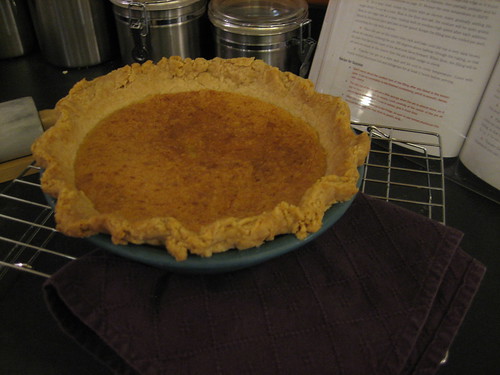
This one is from Page 363 in Mr. Haedrich’s Pie: 300 Tried-And-True Recipes for Delicious Homemade Pie.
Ryan periodically takes a week off from his fifteen foot commute and goes down to California for some face-to-face meetings.
This is the single greatest tragedy in Qubit’s life.
She has a very short memory. One could probably figure out its precise length from the fact that she treats Steve, with whom she once lived, like an acceptable piece of furniture, and Ruth, who picked her for Ryan as a kitten and lived with her for a while, as a potential moving man or monster. But she is particularly prone to forgetting times when she was less pampered than today. In her mind, I’m sure, Ryan has ALWAYS worked from home, and I have always been semi-unemp a writer. Unfettered access to humans at all waking hours is a Ceiling Cat-given right.
And then Ryan goes to California. Which brings us to the Stages of Feline Grief, as observed in Qubit. They may also occur when I leave town, but I doubt they’re as floridly expressed.
Alarm. Marked by whining and running around, trying to figure out why the schedule is off and Ryan is using his luggage to pack things in (instead of letting her sleep in or scratch up said luggage.)
Indignation. Once he’s actually gone, she stalks around with an air of affronted dignity. He’s not in this room! Well, I never! He’s not in this room, either!
Affection. This is my favorite part. She really doesn’t bother with me much, these days. My workspace doesn’t even have a door, after all: I’m her secondary human and I’m devalued by my constant availability. At this point, and periodically throughout the absence, though, she jumps in my lap constantly, purrs at the least provocation, and generally treats me like I’m the center of her world. I think she wants to make sure she holds on to the backup human, at least.
Suspicion. Qubit starts eyeing me from a wary distance, then searches the house. She chooses a closed door (usually the bedroom, since it stays closed) and sits next to it, wailing her distress. This is the door behind which I have obviously imprisoned Ryan, because there’s no other reason he would leave her for over 24 hours. This stage will randomly occur in between bouts of affection.
Joy and Nonchalance. I see her rehearse this every time I come back from a walk or a grocery trip. She runs to greet me, utters a few sharp exclamations about the nerve of leaving her all alone or surprised pleasure at seeing me again, then runs off for a few minutes to make it clear she didn’t miss me. She exhibited this behavior just now, when her horrible ordeal ended and I brought Primary Human back through the door*.
As you can tell, Kübler-Ross didn’t study cats.
*This was supposed to post last night. I guess I failed to press ‘Publish’?
So I took a walk in the rain today down to my local post office. As I’ve mentioned, I am fond of the postal service. I like ink, paper, pens, letters, stamps and post. I also like my local post office. Today I hied me hither because I was walking that way anyway, and because it might give my short story submission a few hours’ jump over home pickup. My carefully paper-clipped story, my SASE, and my signed cover letter were tucked into the traditional manila envelope, laid on my dear little home postal scale, and affixed with no fewer than five stamps (like my colleague Tina I like messing with the stamps) in order to reach the exact postage for a ‘flat’ (big envelope.)
Today, however, escorting my carefully addressed short fiction submission to the ‘stamped mail’ slot, I noticed a sign that said Bring packets and parcels to the main desk. The item in my hand resembled a ‘packet’, so I strolled over to the desk and approached the postal employee — not the one with whom I usually chat. “Am I not allowed to put this in the slot?” quoth I. The lady took the envelope full of hopes and dreams and slapped it on the scale. “I already weighed it…” I protested. She pinched my hopes and dreams appraisingly, then looked at me over her glasses.
“Does this have anything rigid?”
“No. Just a paperclip.”
“That’s rigid!”
“What?”
“That’s rigid. It’s like a key.”
“But…every short fiction writer in the world is probably in trouble,” I babbled. “Editors don’t like staples. Are staples okay?”
“Staples are fine. It’ll be 34 cents more.”
I nodded and managed to buy the stamps I needed before wandering away, feeling (and doubtless looking) poleaxed. If this is true, it means almost every postal submission I’ve ever sent out has been underposted. I imagined that every sub had arrived solely by dint of luck. I imagined my pristine manila envelopes arriving in New York stamped with an angry and inconsiderate “POSTAGE DUE”! I shuddered. And tweeted.
Then I rebelled. Seriously, if my postal submissions are underpaid, but no one notices and they’re getting there just fine, are the clips really a problem? Wouldn’t the editors have objected if they were paying 34 cents a pop for the privilege of turning me down? So here I sit, bending one of my largest paper clips easily to and fro between my thumbs. It is nothing like a key. The USPS website prohibits items in flats that do “not bend easily” or " cause more than 1/4 inch variation in thickness" — to my eye, this clip is fine.
What do you think, fellow writers? Are you willing to pony up an extra buck every three submissions on this nebulous pretext? Do you think my post office is being overly rigid? Anyone know an editor who takes paper submissions well enough to ask whether they get “postage due” often?