I just got my subscriber copy of September’s Asimov’s Science Fiction, so I can now tell you that October/November’s double issue, with my new story “The Termite Queen of Tallulah County”, will be on newsstands August 31!

On a less self-serving note, the September issue contains a story by Campbell Award-winning and all-around wonder Mary Robinette Kowal, who lives in Portland. The August issue, which is still on newsstands for three days only, contains the first published story by Pam Rentz, another great writer of my local acquaintance (she lives in Vancouver.) It’s quite the run of Northwesty scribblers Asimov’s has going (I noticed Kristine Kathryn Rusch in July’s ish, too).

Does a shiny new copy of Asimov’s come to your postbox ten times a year? If not, why not?

I've been Calvin's-Dadded!

Tuesday July 20, 2010 @ 11:51 AM (PDT)

The other morning, I started to type out a tweet. It would eventually be this tweet, declaring my love for my iPhone 4, no matter its overhyped failings. But when I typed it, I typed “I’m glad Apple isn’t responding to this foofraff with a recall…” Then I stared at the word ‘foofraff’, which even as I type it now I hear in my father’s voice, in tones of exasperation. To me, it means “mess”. Used in a phrase: “all this foofraff!” But I wasn’t really sure, so I searched. No hits on Yahoo! Search for foofraff. None. On Google, one…in Polish. It seems not to mean anything in Polish either.

I called my dad. “Dad, I have a very unimportant question for you.”

“Yes?”

“What does ‘foofraff’ mean?”

“Nothing, as far as I know. It’s one of those coined words with no particular meaning.”

“And who coined this word?”

“Oh, I don’t know.”

“It wasn’t by any chance…you?”

My father claims innocence, but how do you explain this nonsense word only he, I, and some person in Poland use? It isn’t the only one. The internet uses “smoorg” but I’m not sure it uses it in our familial sense of “mix together” (Dad says this is “smoog” and comes from the divine Pogo). I constantly have to define “feh” for Ryan (it’s short for “feculence”, obviously!) My dad makes up nicknames for everything from restaurants to electronics stores, and I’ve no doubt he’s gotten creative with slang and nonsense, too.

I also discovered during my brief flirtation with NaNoWriMo five years ago that a whole phylum of my father’s vocabulary came from an unexpected source. I was trying to shrug off my perfectionism by writing pulp. Of course, I started trying to write perfect pulp, and I researched my vocabulary accordingly. My favorite resource was Twists, Slug and Roscoes, which is where I found favored parental word glom and rarer birds like spondulix, as well as more common idioms like cheese it, dingus, hinky, and noodle (in the sense of “use your”). I use these words quite freely, and never realized I might sound like a “wise dame”.

Now sure, you may think that my dad just enjoyed a few issues of Ellery Queen’s in his formative years alongside his Amazing Stories. But perhaps this whole thing has been a linguistic experiment to set his children up with totally outlandish vocabularies. (Or make them play with language until they are compelled to become writers.) Sure, there are only a few examples here, but that’s the whole point: I won’t know how weird the words are until I use them in public.

Unlike Calvin’s Dad, my dad gave me full and, as far as science can be definitive, accurate particulars on why the sky is blue, when dinosaurs roamed, and why old photos are black and white. But his systematic campaign of linguistic misinformation is only now beginning to emerge!

Fruits of the Forest Pie

Monday July 12, 2010 @ 01:54 PM (PDT)

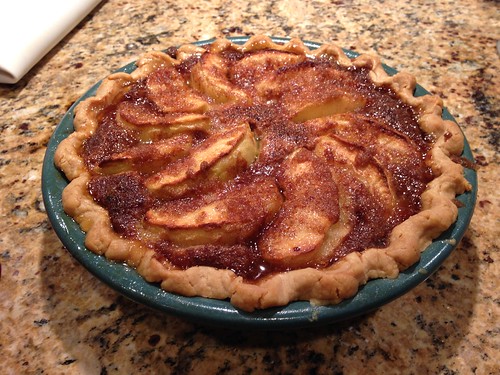
In Ken Haedrich’s Pie: 300 Tried-And-True Recipes for Delicious Homemade Pie, he guesses that the name “Fruits of the Forest Pie” originally applied to a mixed-nut pie, since nuts do actually come from the forest. At some point the name inspired mixed fruit pies, too.

Since I’m allergic to tree nuts, the idea of a mixed nut pie is frightening: I can just handle making, say, a pecan pie for my dad, or a hazelnut pie for Ryan, but multiple types of nuts at once? What if while I’m watching one type of nut, the other two flank me, like in Jurassic Park? Mixed fruit pie doesn’t inspire these delusional ramblings, so that’s what I’ve made:

Closeup of coarse sugar glaze
Fruits of the Forest Pie with coarse sugar glaze

The crust is, as usual, from the family recipe, while the glaze and filling are Haedrich-approved. The filling includes apple, pear, peaches, blueberries, strawberries and pineapple. Won’t find all those in any forest near you.

List slippers

Saturday July 10, 2010 @ 02:54 PM (PDT)
It’s always necessary to remember that the fiction writer is much less immediately concerned with grand ideas and bristling emotions than he is with putting list slippers on clerks. -Flannery O’Connor, Mystery and Manners

In my last blog post, I meant to include this quote. (In fact, at one point I intended to call the post “Collecting List Slippers” in its honor.)

In context, O’Connor refers to Madame Bovary:

Sometimes she would draw; and it was great amusement to Charles to stand there bolt upright and watch her bend over her cardboard, with eyes half-closed the better to see her work, or rolling, between her fingers, little bread-pellets. As to the piano, the more quickly her fingers glided over it the more he wondered. She struck the notes with aplomb, and ran from top to bottom of the keyboard without a break. Thus shaken up, the old instrument, whose strings buzzed, could be heard at the other end of the village when the window was open, and often the bailiff’s clerk, passing along the highroad bare-headed and in list slippers, stopped to listen, his sheet of paper in his hand.

In yet further explanation, I proffer this link about the nature of list slippers, shoes made, sole and all, from fabric and thus very quiet to walk in. (Although in the quote above, I think their informality rather than their stealth is their primary characteristic.)

Okay, so obviously this quote needs a lot of unpacking, and perhaps it’s just as well that I left it out of the other post. But it also deserves more than the slight mention I’ve already given it — it’s a massively important point about writing made succinctly and pungently. I think of these list slippers every other day or so.

As everyone’s friend John Gardner writes in his Art of Fiction, “If we carefully inspect our experience as we read, we discover that the importance of physical detail is that it creates for us a kind of dream, a rich and vivid play in the mind.” As writers, we are trying to do so many things: amuse, inspire, impassion. But we have to see the small as well as the large. We build our castles in the air one brick at a time. Everything matters, from list slippers and the buzz of piano strings up to despair and delusion.

Everything matters. How could I not love that?

Observations

Tuesday July 06, 2010 @ 12:46 PM (PDT)

One of the first things I learned in writing school was to watch more closely. My first advisor in graduate school (and author of the upcoming MFA in a Box), John Rember, pointed out to me that being a writer is not just writing: it’s how you see the world.

Before I went to grad school, I already loved little idiosyncratic details. I loved noticing how one thing was so unexpectedly like another, and deploying that likeness in prose to give someone a jolt of recognition. I loved stealing a gesture from a passerby and teasing it out into a character. But I more or less relied on those details to come to me. I wrote things down when I noticed them, but I didn’t go out into the world, eyes open, ears pricked and (figurative) antennae agape in order to gather them. Now I do.

A few things I have noticed recently:

  • A lone strawberry sitting in the road on a rural highway, pointing up like a caltrop.
  • A man in an workman’s orange vest sitting on a traffic control box he had scaled with the help of a nearby stepladder. He was holding a package and apparently doing nothing.
  • Teenage girls in summer dresses stealing a series of appraising glances at disreputably attired young men getting out of a van next to a venue (and thus, presumably, in a band).
  • A highly-polished Jaguar in a shade of gold so extreme as to resemble baby poop, with scythed wheels.
  • A petite woman in silver shoes and a sequined tunic posing motionless for a long time while her photographer fiddled with his camera.
  • A man in baggy khakis and a burgundy polo crossing Terwilliger to stare fixedly into the sloping forest. He looked exactly like Bill Gates.
  • Lanky siblings, long and slender with their teenage growth, cramming themselves onto swings and seesaws at the park and trading insults and boasts. Their hair was a light fine blond, like toddlers’, but their brows were dark and straight.

These are the observations that lent themselves to blogular explanation, not the weird sensory notes that will take some time to resolve and render into words. Not all of these are worth using. None of them immediately gives me a story seed (give me time.) But I accrete these images and moments all the time, and it’s hard to predict when one will blossom, or, set next to my current idea or problem, suddenly connect. Moreover, just collecting them gives me a sense of glee. It makes me feel a part of the world, its weirdness and whimsy and occasional joy.

In Psych 101, we learned that you could strengthen your sense of smell by practicing. Our professor noted that many people didn’t want to increase their nasal sensitivity because they thought they would be inundated with bad smells, but this isn’t the case. She said that apparently the brain always registers bad smells, because they are potential threats: when you train up your nose, you smell more (and more complex) pleasant or neutral odors. I immediately started training my nose.

I wonder if there’s a similar effect with the multi-sensory observations I make of the world. I noticed some time ago that I am generally happier, mellower and more at peace than I used to be, and I wonder if part of this is from the discipline of observation I’ve acquired. “The impulse to write comes from the impulse to love,” my final advisor, Jack Driscoll, says. Perhaps observing the world closely is a way of loving it.

Update: Related post here.

Felicity's Independence Pies

Photo by Ryan, who very rightly notes that the vanilla cream pie on the right (the others are Strawberry Chiffon and apple) has blue filling. For the patriotism. The gooey, gooey patriotism.

Day trip: White River Falls

Monday June 28, 2010 @ 01:32 PM (PDT)

I thought I’d post a photo from the trip Ryan and I took this weekend to White River Falls State Park, just a bit south of The Dalles in our fine Beaver State.

White River Falls -- Upper and Lower

As a side note for gadget geeks, this photo (and my other photos from the trip) were taken with my new iPhone 4. Not bad for a phone.

Discomfort zones

Saturday June 26, 2010 @ 09:57 PM (PDT)

Last night I finished a story which I started writing in March. I’m not the most linear person in the world, and I often let stories in progress lie fallow while I work on something else. But in theory this story has been my main compositional task all this time. In theory, I was going to turn it in to my critique group for comments in April, and May, and June.

Now sure, it ended up longer than I’d thought, and I had some structural doubts in the middle that had to be solved with six colors of whiteboard marker and some diagrams, but all that happened after I really got into writing it. It took me months just to feel sure of the person, tone and voice; to stop writing beginnings and scratching them out; to get beyond the second scene.

I’m pretty sure I know what was going on here. This story was way out of my comfort zones. For one thing, it was set in an uncomfortable time period: what you might call the middle future. The next few decades? Fairly easy to write. Turn the tech we have now to eleven, add a few things currently in R&D, a startling new discovery if you need it for the plot. You extrapolate the current social trends and cultural trappings. Far future? You just go hog-wild. The middle future — say, a century from now — is pesky. You can barely start to extrapolate how we’ll get there from here, and yet you can’t exactly press “up and out” on the space elevator of your mind.

Folks who don’t write science fiction are unlikely to come against the time frame problem. Writers of historical fiction may, though: there’s that desire to set a story in a period and the feeling that you just don’t know it well enough yet. It’s easy to spend months researching just to get confident enough to write. For fantasy, the need to map out a new and alien second world and its history before setting pen to paper might be similar.

One comfort problem I think any fictionist might encounter was the other main obstacle for this story: distance from the character. My protagonist is an athlete. I, anyone who knows me well may attest, am only an athlete if you adhere to marketing feel-good messages about everyone being one. (If everyone’s an athlete, no one is?) It was kind of a ridiculous thing to get hung up on, since I’ve written moms, monsters and teenage boys, but still, I felt intimidated by the distance between her experience and my own. Thank goodness I chose a sport for her that I actually love, or I might still be trying to write that third scene and failing.

I’m not sure how well this story turned out, yet. If the proof is in the pudding, stories take a while to get to pudding stage. But I can be pretty sure that working through this and pushing past my comfort zones is a good thing. For one thing, I feel a stronger sense of accomplishment than I would if it had been easy. (Isn’t that part of why I’m a writer in the first place? Because it’s deliciously hard?) For another, it may be good for me, my stories and my skills. Ron Carlson, a versatile short story writer, told Quick Fiction, “I also think that if you write stories for years, you do develop or sense a rhythm, and when I sensed that my stories were all rounding the corner at about four thousand words, I changed that rhythm.”

Is comfort the enemy of art? Does changing things around keep you fruitfully off-balance? (My oboe teacher went to a master class for all sorts of instrumentalists once where they stood on a little platform which they had to balance as they played. In each case, the musician’s performance improved.) It may be a good thing to do the same thing Ron’s discussing with genre (or subgenre), type of protagonist, first versus third person, anything else that becomes too easy. Maybe discomfort is good for us as writers, working out different muscles, finding new things to say and convincing ourselves we can accomplish unfamiliar tasks. The first part of being a writer, after all, is having the confidence to speak.

Get out there and be uncomfortable! From this side of the experience, it feels pretty good.

On a bookshelf near you

Thursday June 17, 2010 @ 03:24 PM (PDT)
Is Anybody Out There? on the shelves at Powell's

I took this picture last week — Is Anybody Out There?, edited by Nick Gevers and Marty Halpern on the shelves at Powell’s City of Books (Sci-Fi/Fantasy section, Anthology bookshelves). Of course, when I first saw it there the previous week, there were two copies!

Updated to add: I don’t plan to be this spammy every time I get something in an anthology. This is just the first time there is a book with my name anywhere on it (back cover, POW!) and I will simmer down shortly. When I get a book of my very entire own published, however, this level of bloggery will seem by contrast quite mild.

Dream Locations

Monday June 14, 2010 @ 11:03 PM (PDT)

I recently visited the Kennedy School McMenamin’s for the first time, and upon driving into the parking lot, was a little disturbed. Despite being quite certain I’d never been there — and despite its being a glorious summer afternoon — I remembered being there in a dim twilight, issuing out of the double doors and milling in half-reluctant revelry with familiar strangers. In short, I’d dreamed about a place that looked quite like it.

Usually my dreams take place in locales I have actually visited, but I find they often are set in the same places, over and over. There was a house of a casual schoolfriend that appeared often — this confused me until I realized it shared a layout with at least six other houses visited in my suburban childhood. I also have the odd dream set in the house where I grew up — we lived there 12 years, after all. One thing I notice about indoor dreams is the presence of stairways. The dream-images of my childhood house are of the basement stairs, or the kitchen nook between them and the upstairs flight. That friend’s house, the oft-repeated house with the familiar layout? A split-level. I’m usually coming in the front door.

Almost every dream I’ve had set in my high school, too, during and after my stay, was set in the great hall or the two stairwells that bracketed it — going up to a mezzanine, down to a basement. Small surprise, then, that after over a month’s cumulative substitute-teaching in that remodeled school, I still occasionally head for a stairway that isn’t there.

What locales recur in your dreams?

Copyright © 2010 Felicity Shoulders. All rights reserved.
Powered by Thoth.