Today’s catch: A twenty-something white man in Buddy Holly glasses with a hot pink skateboard strapped to his backpack. He was practicing the moonwalk at a bus stop in the rain.
Archived Posts
Displaying posts 31 - 40 of 878
I am not 100% sure the issue is on newsstands yet (it’s the May issue, with a cover story on Farmer’s Markets), but Portland Monthly Magazine has put their article about Portland Nebula Nominees Mary Robinette Kowal, M.K. Hobson and me online!
Here is the link! Article by our own Camille Alexa and photograph (complete with Marla face) by Michael Cogliantry.
I will cop to finding this pretty exciting!
Recently I’ve gotten my picture taken much more than usual. No great mystery why: the Nebula nomination. I think most of us are rendered uncomfortable and self-conscious by having photos taken, especially ones we know “matter” — no matter how many candids are taken of us as children by snap-happy parents, as adults most of us are anxious about the process.
My recent adventures in digital gaze actually began a year before the Nebula nomination, when I roped my dad into trying to take an author headshot for me. The light wasn’t great and I didn’t choose my clothes all that well, but we got something I can use and currently do. The big revelation, however, was that I am horrible at posing, and even at judging my own shots. Ryan says just about every shot of me looking “serious” makes me look bored — and he has a lot more experience with my expressions than I do.
I suppose posing is like anything else where your body has to produce an effect your mind doesn’t fully understand: you have to learn to trick yourself, and without a toolbag of tricks, you’re flailing around with little hope.
A few weeks ago I went to my first ever professional photoshoot: Portland Monthly Magazine wanted a photograph to go along with a column on local Nebula nominees M.K. Hobson, Mary Robinette Kowal, and me. This was incredibly fun: there were floating antique typewriters (converted from floatless models in Mary Robinette’s collection) and flying pieces of paper and cups of free coffee from one of my favorite Portland coffeehouses, Case Study. But at several points I was asked to look “angry”, intense, like I hated the camera. And I say at several points because the other two subjects only had to be asked once.
This is actually quite funny to me, because I think I play angry reasonably well — in motion and speech. I scared a fellow student once when we did the “kill Claudio” speech from Much Ado About Nothing for class (I was Beatrice, natch.) A fellow roleplayer in my first LARP went out-of-character to make sure his buffoonish character’s chauvinistic comments weren’t actually bothering me — he said I seemed actually livid. But in stillness, apparently, my hating the camera has little effect.
It was Mary Hobson who saved the day by saying “think about Marla from Fight Club!” How could she have known I had just rewatched Fight Club — and just lost my longstanding distaste for Helena Bonham Carter thanks to The King’s Speech? I tried Marla. She hates the camera with world-weary ennui, and has complete contempt for it. The reminders to look angry ceased and the fun continued.
The other day I had a solo portrait shot by a professional photographer for my high school alma mater‘s alumni magazine (I’m trying to keep this a secret from my mom, but if she’s reading my blog this regularly she deserves to find out!) After a few different sorts of smiles and some “serious” expressions (will I look bored in those?), the photographer told me to do angry. I summoned my Marla impression at once, and he shook his head. “Whoa! Too much.”
I’m learning!
My latest story in Asimov’s Science Fiction, “Apocalypse Daily”, is on shelves in the June 2011 issue! (Click the name of the story to read the first few paragraphs!)
This is what it looks like:
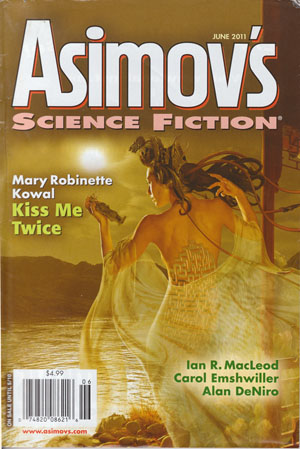
As you can see, the headlining novella is from Portland’s own Mary Robinette Kowal, Nebula-nominated novelist! Two Portland people! Don’t you just need a copy?
Getting a paper copy: Traditional newsstands often carry Asimov’s. Many Barnes & Noble locations carry it, but it’s best to call ahead if you’ve never spied it out at that particular store before.
Portlanders allergic to big chain stores can head down to Rich’s Cigar Store, which carries Asimov’s in their extensive magazine collection. The main store on SW Alder has the most copies. Also, the main store will ship magazines to out-of-town customers — call them up!
Digital versions will be available soon at Amazon, B&N, Sony, Fictionwise, et c. I will update this post as I discover these editions are available.
This is just a note to explain my sudden transition from prolixity to paucity here on the blog: we have found out we need to find a new rental house sooner than expected. With all manner of business coming up, and the Nebulas besides, we’ve been very focused on getting this dealt with as soon as possible. And we’ve been successful! We signed a lease on a new house and will be moving this week. Quite the whirlwind.
I hope to be back here bending your ear with more unsolicited advice and rambling musings soon enough.
I have had, and thoroughly enjoyed, two semesters of formal training in Latin. (In addition to a few private lessons from my retired Latin teacher grandma when I was ten.) This is just enough Latin to be dangerous: enough to, say, puzzle out the odd inscription or be confused by the differences between liturgical and classical. Enough Latin to see the bones lying under the skin of our own language.
I am also a perfectionist. A perfectionist of a particularly pernicious persuasion: a procrastinating one. This is often a problem for me, but in the most important sphere of my life, the writing one, I think I’ve made my peace with it. Writing can never be perfect, only as good as we can make it with the vision and skill we have available to us. Someday our vision or skill may be better, but now we have to surrender and give up our offering to the world, imperfect.
Or is it? We are so accustomed to thinking of perfect in its English sense, (OED definition 1a: “Of, marked, or characterized by supreme moral or spiritual excellence or virtue; righteous, holy; immaculate; spiritually pure or blameless”) but I prefer its Latin origins: per, through or throughout; and the past participle of facere, to do or make.
That which is perfect has been gone through; that which is perfect is thoroughly made. That, the shape of the word which I feel through the flesh of use and connotation when I heft it, I celebrate and do not fear. Perfection doesn’t have to be an impossible, theoretical absolute. All of us, perfectionists or not, can aspire to produce something that is rigorously, mindfully conceived and carried through with care: something that is thoroughly made.
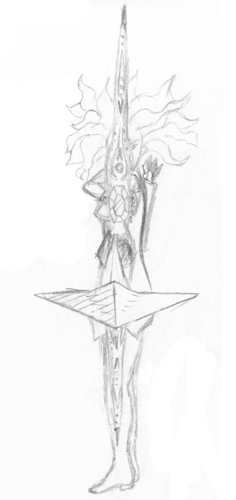
A drawing I did of an Exalted character c. 2003. “Good enough” for what?
I’ve never thought much of myself as an artist. All right, that’s a lie: as a child, I thought I was pretty awesome. But I was also pretty sure I would someday find a magic sword in a stone, so take my cherished beliefs with all the salt you like. And even then, I could tell that I didn’t have an overpowering natural gift: it took a lot of work for me to get a drawing up to second-place snuff, when the first-place kid tossed his off in no time. I admit, this may have discouraged me. While my mom, herself dissuaded from trying at art at a young age, forbade me to say I was “bad at drawing”, I decided to be cheerfully “mediocre at drawing” or at best “okay at drawing”.
In my adult life, I mostly use the “okay” drawing skills I nursed through Drawing classes and Scientific Illustration activity to draw my roleplaying game characters. (It’s okay, if you were on this website you would have worked out that I’m a giant dork eventually.) My spotty skills are enough, usually, to falter out a much-corrected portrait of my character that satisfies me. The clothes are usually just right. Often I am pleased with the face. The pose is almost always awkward.
I made the dreadful mistake of showing these things to my friend Lee Moyer. Lee is an immensely talented and prolific professional artist and illustrator. Very professional. I can’t remember why I committed the mad act of showing him my sketchbook, but probably because we were going to Ambercon together, and he would inevitably see me scribbling at some point. Might as well preemptively show him the whole ugly mess, I must have thought.
Well, he didn’t cry out in horror, and to my knowledge he didn’t lose sanity points. Instead, he did the next-worst thing: he encouraged me. He told me that with more discipline, I could draw well. He told me that with better tools, I could draw more quickly. Somehow I’d managed to get my innate ambition and perfectionism to overlook this one area, but now it has noticed art again, and all may well be lost. Because if I can do well at something, then of course I had jolly well better. All these years, I’ve been trying to make the individual drawing better without working on my overall skills, without spending time preparing, working things out, or getting references. The end results may have been within my bounds of satisfaction, but they could have been much better much faster if I’d been willing to work on my drawing as a whole and give the activity a little more time.
Now that I am ambitious about drawing again, it’s hard to believe I managed not to be for so long. I try to imagine someone with just an ounce of talent telling me, “It’s okay, I don’t need to get better at writing: I only use it for my RPG character journals.” Why wouldn’t you get better at something if you could? Why do something if it’s not worth practicing? What was I thinking?
And what am I in for now? (One thing’s almost certain: you will be seeing a lot more “cross-training” posts about the similarities between writing and visual art.)
Yesterday Ryan and I continued our Peter Weir kick (which has already taught me that Australia itself, not just its fauna, wants to eat you) by rewatching The Truman Show. In case you don’t remember, Truman’s annoying TV-wife does forced, saccharine product-placement bits and nags him to have a kid to complete their suburban-perfection lifestyle. Her character-within-a-character is incredibly conservative, intrinsically conservative in the textbook sense: she functions to keep Truman the same; she is the caretaker of their retro, confined fantasy of a white middle-class heterosexual utopia.
And, trying to smooth over Truman’s accidental glimpse into a backstage area through an elevator door, she tells him about an “elevator disaster downtown” caused by “those non-union workers. Monstrous!”
I have to admit, this threw me for a moment. The climate has turned against unions so fast that this line, from a 1998 movie, seems nonsensical. Sure, thanks to a tip from Camille Alexa I know that Ronald Reagan said unions were a basic right. But in spite of his conservative canonization, Reagan was a while ago. In just 13 years, we’ve gone from an artificial shill of corporations and conservatism casually lambasting non-union labor to the GOP trying to break the back of unions across the country.
I like to understand why things are happening. We all do: that’s why conspiracy theories are so popular, because lack of explanation is primally terrifying. But more, as a history nerd and someone who thinks in stories, I want to know how we got here from there. I’m going to have to read up on it, because it boggles the mind. It seems like a nationwide revolution has been accomplished by sleight-of-hand within my lifetime. How can the wind change so entirely in such a short time? Why is the history of labor in America so often hidden history, when this is a country built by greed and baptized in the sweat of workers?
My first advisor in graduate school had a huge influence on me. I had several fabulous teachers in the program, but working with John Rember set the foundation of my writing life. He got me to state with confidence “I’m a writer” and taught me that being a writer is a continuous state of being and seeing, not something you just do when you write. The books I read at his behest and discussed with him in my correspondence semester helped give definition and certainty to things I had felt as instinct and hunch: things about the importance of writing, writing as survival strategy, writing as making meaning.
John’s craft talks at the program were also rich and valuable. They were the sort of lecture where you scribble notes intensely, and you can’t keep up with all of it that you want to get down, and you also want to be writing your own notes about all the things in your own writing and life that hook into what he’s saying, all the ideas this gives you. Luckily, many of the rich, layered craft talks that he wrote for the Pacific program are now available to me in a more complete and much more legible format than my own scribbles: printed essays in book.
 John has written a writing book, MFA in a Box, which I am reading. To be honest, I’m reading it very slowly. That may sound like an odd endorsement, but it’s an honest one. I started reading the book on the plane to a convention. Every chapter is an essay, one of those rich interconnected thought-weavings that we got to listen to as Pacific students, with the addition of a top ten list at the end of each — valuable for focus and review, but also often funny. I found, reading on the plane, that when I was done with the first essay, I didn’t want to read the second. I wanted to write. So I dug out my carry-on and switched activities. On the plane ride home? Same thing. One essay, and then writing.
Obviously, this is a rare writing book. I have read quite a few, and I don’t remember any of them making me want to write that moment like this does. The cover says it’s “a Why to Write Book”, and the evidence says it’s convincing.
So the good news about John’s splendid craft talks is that you can buy the book, and the bonus good news is that you can read his blog while you’re waiting for the book to arrive. It’s a relatively new blog that he’s started in support of the book (hence the name!) and it is chock-full of the stuff John Rember specializes in as a teacher: thoughtful, mordant, lucid non-fiction about things which are important and hard to tackle.
Here are some of his posts:
- Narcissism and Depth, which may obviate or at least mutate two blog posts I meant to write here
- The Wannabe Writer, about stopping pretending to be a writer and actually being one.
- A Writer’s Meta-Narrative, about the stories everyone lives by, not just storytellers
I don’t think I’ve ever written a blog post just to recommend another blog before. Maybe John’s blog isn’t the blog for you, if you’re not a writer or interested in writing, or don’t like hard questions. But I am so glad it’s there, that someone with so much experience and so much willingness to examine it honestly is sharing in this way. John as teacher is challenging, wise, and dryly, darkly funny. John as blogger is much the same.
Here’s yet another of those topics I’d have sworn I’d already covered here, but apparently I have not.
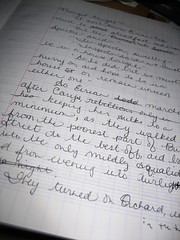
The other day I finished writing a longhand draft (126 pages, not pictured) of a long novelette. The problem that then confronted me was that I had to get the thing typed into the computer in time to send it to my critique group in only a couple of days (in case you were wondering why I hadn’t blogged recently!) I posted about this challenge on Facebook and Twitter, and one of the responses on Facebook was: “You can do it, but why would you write in longhand to begin with? Embrace the 21st century!”
Which is how I ended up discovering I don’t have a blog post about this to which I can direct people when they ask, because they do ask. I have mentioned my process obliquely but never written up the defense I’ve had to give verbally many times.
Why I write longhand first drafts
1. Transcription is revision: When I transcribe a finished draft into the computer, I don’t type it exactly as I wrote it. It is no more effort to type different words than it is to write the same ones — and less if I can make the sentence smaller (which usually means clearer and more efficient). When I transcribe a story, I reconsider every single word in a way I simply don’t when reading a typed document. This is by far the most important reason I write longhand. The draft that goes in the computer — the first one anyone else can read (given how my handwriting gets when I’m in a hurry, quite literally) — is lightyears better than the handwritten draft that no one sees. Rewriting the entire story, starting at the beginning, with the end freshly in mind allows me to grasp the story as a whole and helps me improve continuity, too.
2. Process: A related point. When I’m writing a rough draft, I don’t always know what the characters’ names are, or what precise order things should follow. Rekeying the entire story means I can easily replace the placeholder names (or epithets) on the fly. More importantly, while I’m writing, if I think of something I should have written in a scene ago, or decide to move something, I can note it quickly with a marginal note — “add desc of room” or “move after reveal” — without losing the forward momentum of composition. My bookmark or thumb is still holding the current page, I didn’t have to do the copy-paste to move the stuff, make sure it was tidy and unrepetitious, and completely lose my creative place. Writing longhand has a great forward flow.
3. Distraction reduction: My favorite notebooks, by Clairefontaine, have many fine qualities, but they don’t have an internet connection. It is less easy for me to be pulled out of that forward flow by a communication or my own fidgetiness. Even more importantly, for a person as easily drawn into small and often non-germane research topics, it means it’s not easy for me to open a tab and start doing lots of searching and reading about something that doesn’t really matter to the story. I can just scrawl a “[?]” or “[check]” or “[did they already have this in 1919?]” and keep going. When I transcribe, that’s when I get fiddly and detail-oriented — a much better fit for a revising mindset than it is for a composing one.
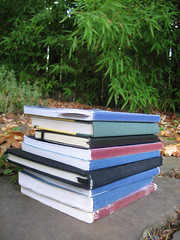
4. Portability: My beloved Clairefontaines are under 7 inches by 9 inches. Even my smallest messenger bag can fit more than one of these puppies. So when I’m waiting for my Chinese takeout, early for a lunch date (don’t laugh, that’s happened), proctoring a test in my capacity as an occasional substitute teacher, or on a long drive with Ryan, I can whip this out and be working on a draft — with full access to what came before — in moments.
5. Psychology: I come from at least one line of makers. My paternal grandpa could build a house. My paternal grandma could renovate a hotel to period-accuracy, make beautiful furniture, and sew entire wardrobes including wool coats and formalwear. Between them, they taught me to cook, tole-paint, make model airplanes and build a remarkably sturdy footstool (still in use, albeit at my parents’ house. I want that back!) Much as my psychology is keyed to celebrate upon finishing things, it’s even more satisfying to be able to hold up a physical finished item and rejoice. When I finish a first draft, I like to pinch the silk-smooth french-ruled sheets of paper together and look at their thickness. Look at all those pages of words. I made that.
So what?
I have no idea if this will convince those of you who think I’m ridiculous to write longhand that I know what I’m doing. There are lots of other ways to deal with these problems or accomplish these goals — this just happens to be mine. The bottom line is that I believe I produce better fiction writing this way. If you read my stuff, you should appreciate that!
You’ll notice, however, that I have written this post in the first person. I do not believe there’s One True Way to write fiction or anything else. I believe much of the journey of writing is learning (and gaming) yourself and your process. I would never tell anyone else they needed to write longhand (although I might list it as among possible exercises should they need a lot of process shake-up). I would never promise that I’ll always write this way. Writing — which is to say, learning to write, as they’re the same thing — is a process of growth and change.
What do you do in your writing, crafting or artistic process that might seem odd to someone else?